

For many Visionaries, hiring an Integrator feels like a structural turning point.
After months of debate, interviews, and internal alignment, the decision finally lands. The role promises relief. Execution should stabilize. Accountability should improve. The founder should be able to step out of the day‑to‑day and return focus to growth, relationships, and long‑range strategy.
For a brief moment, it works.
Then, quietly, the strain returns.
Meetings get longer instead of clearer. Decisions slow rather than accelerate. Team leaders feel managed but not supported. The Visionary finds themselves back in operational detail—often more than before. Nothing collapses dramatically, but momentum erodes. Trust thins. By the end of the first year, the organization is more fatigued than when the role was empty.
This pattern is not rare. It is one of the most expensive breakdowns Visionary‑led organizations experience—and one of the most consistently misdiagnosed.
The Common Misdiagnosis
When an Integrator hire fails, leaders tend to reach for familiar explanations.
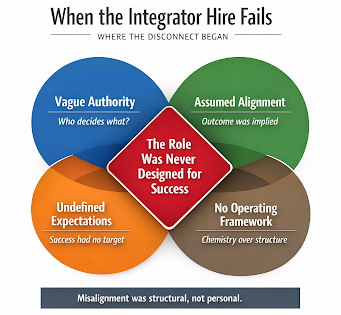 The person wasn’t strong enough. The chemistry wasn’t right. The organization moved too fast. The Visionary wasn’t ready to let go.
Each explanation contains a grain of truth. None address the real failure.
In most cases, the Integrator did not fail because of capability, effort, or intent. The hire failed because the role itself was never fully designed for success.
The organization hired a person into an assumed role, rather than constructing a clearly defined operating position with explicit authority, ownership, and outcomes.
Why the Integrator Role Is Structurally Different
Unlike functional leadership roles, the Integrator does not sit neatly within one lane of the organization. The role exists at the intersection of strategy and execution, authority and influence, structure and relationship.
An effective Integrator:
- Translates vision into operational priorities
- Creates clarity across departments without owning all decisions
- Holds peers accountable without positional dominance
- Partners with the Visionary without becoming subordinate or oppositional
This makes the role uniquely sensitive to ambiguity.
When success criteria are vague, when decision rights are implied rather than explicit, or when the partnership model is left to evolve informally, friction becomes inevitable. The Integrator absorbs tension from every direction, while the organization quietly waits for relief that never arrives.

The Cost Leaders See First
The most visible costs surface quickly.
Compensation paid during the tenure produces little durable return. Leadership time is consumed onboarding, coaching, and recalibrating. Strategic initiatives slow while the organization waits for operational clarity to take hold.
These costs feel measurable. They show up in budgets, calendars, and board conversations. Many leadership teams stop their analysis here and conclude the role is simply too risky to attempt again.
That conclusion misses the deeper damage.
The Cost Leaders Rarely Measure
The real expense of a failed Integrator hire is not financial. It is cognitive and organizational.
While the organization attempts to stabilize, senior leaders divert attention away from growth. Meetings multiply. Informal workarounds replace clear ownership. Decision‑making drifts back toward the Visionary, even when no one explicitly intends it to.
Over time, second‑order effects appear:
- Leadership development stalls
- Accountability conversations soften or disappear
- Role boundaries blur across the executive team
- High performers hesitate to take initiative without clarity
None of these effects appear on a financial statement. All of them slow the organization.
Why Distraction Becomes the Most Expensive Outcome
Distraction is the most underestimated consequence of an Integrator mis‑hire.
When the role does not function as designed, it consumes disproportionate attention. Leaders revisit decisions already made. Teams wait for alignment that never fully materializes. The Visionary re‑enters operational detail, unintentionally signaling that roles and authority are conditional.
This pattern reshapes behavior.

Leaders stop pushing for bold moves. Teams lower expectations. The organization becomes cautious—not because strategy is unclear, but because execution feels fragile.
Recovering from this state takes far longer than replacing a single leader. Focus must be rebuilt. Confidence must return. Trust in structure must be re‑earned.
How Failed Integrator Hires Undermine Commitment
After a mis‑hire, hesitation sets in.
The Visionary questions judgment. The leadership team doubts the process. The organization delays re‑engaging the role, redistributing responsibilities informally instead.
This avoidance carries its own cost. Without a clearly designed Integrator role:
- Decision rights remain fuzzy
- Accountability weakens
- Execution depends on individual heroics
The very issues the Integrator was meant to resolve deepen over time.
The Real Failure Point
Most Integrator hires fail long before the start date.
They fail when the organization cannot answer, in writing:
- What outcomes this role owns
- What authority this role holds
- Where decision rights begin and end
- How success will be measured at 90, 180, and 365 days
- What the Visionary–Integrator partnership requires to function
Without this clarity, even capable leaders are set up to struggle. Performance issues that appear interpersonal are, in reality, structural.
Why Hiring Differently Matters
The Integrator role demands a higher standard—not of talent, but of role design.
Organizations that succeed treat the hire as a process decision, not a personnel decision. They define success before evaluating candidates. They align leadership expectations explicitly. They design the operating relationship with the same rigor applied to strategy or capital allocation.
When the role is designed clearly, the Integrator amplifies execution, strengthens culture, and restores momentum. When it is not, the organization absorbs quiet drag that compounds over time.
What Stability Looks Like
When the Integrator role is designed and filled correctly:
- Decision‑making accelerates
- Accountability becomes cleaner, not heavier
- The Visionary regains strategic altitude
- Leaders operate with clearer ownership
The difference is not effort. It is structure.
The Bottom Line
An Integrator mis‑hire costs far more than compensation or transition expense. It diverts focus, erodes confidence, and weakens commitment to the very structure the organization needs to scale.
For Visionary‑led organizations, the question is not whether the Integrator role is risky. The risk begins when the role is hired before it is fully designed.
If this pattern feels familiar, the issue is likely structural, not personal.