

In my second job and in my early 20’s, I was fortunate to have earned the recognition and appreciation of my boss, the VP of HR and the CEO of a publicly traded company. My VP was a loyal, dedicated man, a patient leader, and a realist about his own strengths and weaknesses.
He knew his risk-adverse nature was often at odds with the assertive goals of the CEO, so he was happy to delegate projects that were big, unwieldy, and lacking definitive parameters. The fact I viewed the same projects as inspiring, challenging, and daring made us the perfect combination!
As a result, I took half of my direction from the VP, and half from Tony, the CEO. We accomplished some amazing things in a relatively short period of time. I was one of seven people who were charged to expand business into Mexico within 9 months. We also implemented a Hay-based Salary Administration Program, and we implemented a new performance review process while executing the daily responsibilities of the HR department.
Tony came to rely on me getting stuff done, and if I ran into a road block or speed bump, he would know when I’d show up at his office door, magic wand in hand, telling him “it’s out of juice!” We would troubleshoot, problem solve, and then I’d be off to the races.
I LOVED my job!
Then…Tony knew his corporate vision was going to require some major leadership development beyond what our department could support. He hired Sam, a VP of Organizational Development to lead such a department which was separate and distinct from ours.

I really shouldn’t have had to deal with Sam much, but our paths often crossed, or collided…maybe crashed. He was the ultimate bully who needed to put others down, if not demoralize them, in order to elevate himself.
I distinctly remember one meeting in which I needed to introduce him to two of our established vendors who could assist him in some project. He was so arrogant, aggressively denigrating, and openly insulting me, it was everything I could do not to cry, but I WOULD NOT CRY! To prevent this, I focused intently on the words of my coffee cup which began to shimmer and shake from the intensity of my gaze.
Eventually the meeting was over and we all left his office - of course it was his office. To my surprise, later that afternoon, the two vendors called me independently, to apologize for the manner in which Sam treated me.
That helped me understand I wasn’t crazy, but I still had to deal with him. I couldn’t exactly whine about him, but came to realize he treated all those “below him” in a similar manner.
Over time, the dread of dealing with Sam overshadowed everything I loved about my role.
When I resigned, I asked Tony if he had time to discuss my departure and time was scheduled. Sam actually called me to schedule my exit interview. I declined. He proceeded to rant at me about who exactly, did I think, “at my level,” I would have expected to conduct the exit interview. There was dead silence when I informed him I already scheduled time with Tony.

Tony listened patiently and intently as I explained many experiences in enduring Sam’s tirades, and many others who had experienced the same, including our CFO who within 24 hours of one of these episodes, went into early labor.
Our CFO, the head of IT, the head of internal audit, and I all considered ourselves professionals and so tried to endure, but in HR, I believed it was hypocritical for me to recruit for an organization who would send their high-potentials to this bully for development. I also believed, whether or not Tony knew what a loose cannon he had in the role of VP of O&D, he needed to understand as an internal advisor, I believed he had a liability on his hands.
What came next shocked me and it is one of the most significant lessons I learned in my life. Tony, very compassionately, and very professionally (no patronizing, no condescension) asked why I didn’t just leave the meeting? I was stunned! He clarified: I’m not suggesting you storm out or create a scene, just excuse yourself and walk out the door. If you’re up for it, suggest rescheduling for a time when it can be conducted with more professionalism.
We continued to talk and I agreed to have another conversation with Sam, in my office, after Tony spoke with him, to explain the repercussions of his actions, and the exposure he created for the company. But I took that lesson with me for the rest of my life!
I’ve since learned about a framework called Transactional Analysis (TA), developed by Eric Berne.
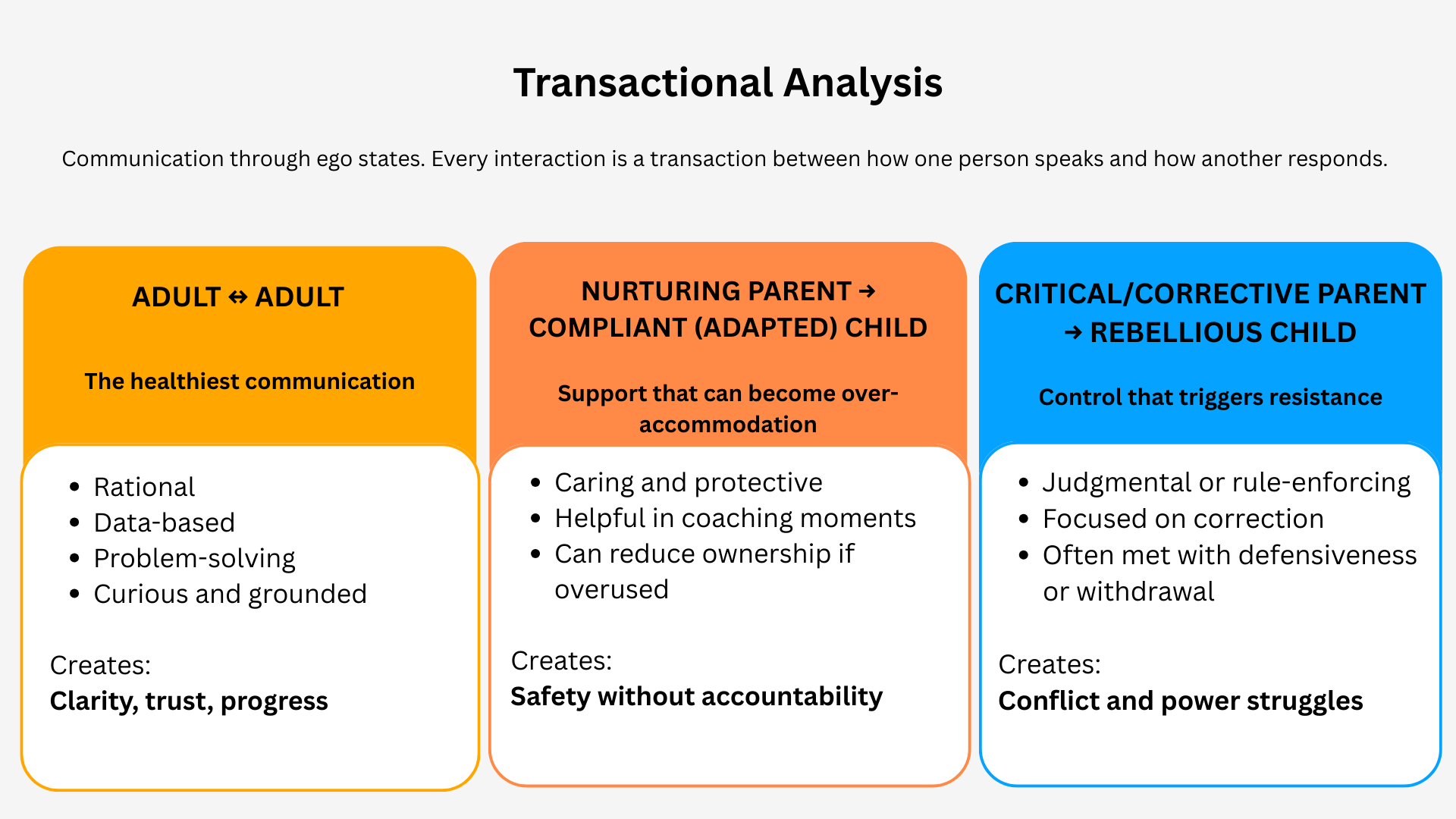
Transactional Analysis describes communication through ego states:
- Adult ↔ Adult
Rational, data-based, problem-solving communication (the healthiest, most effective state). - Nurturing Parent → Compliant (Adapted) Child
Supportive, caring, protective communication that can become over-accommodating if overused. - Critical/Corrective Parent → Rebellious Child
Controlling, judgmental, rule-enforcing communication that often triggers resistance or defiance.
In TA, every interaction is a transaction between ego states:
- Problems arise when people talk Adult-to-Adult but respond Parent-to-Child (or vice versa).
- Strong leadership, coaching, and conflict resolution aim to restore Adult-to-Adult communication.
In business, so much can be accomplished when leaders and direct reports all work to communicate as adults. None of the parent or child states are really useful.
Clearly, bullies like Sam, overuse the Critical Parent state which immediately puts the other person in a Compliant or Rebellious Child state. Once aware of this framework, it’s easy to spot when a situation has deteriorated to the unproductive states, and awareness can help prevent you from being pulled into one of those states. It still requires inner strength and practice to move the conversation into Adult-to-Adult without sliding into a little Critical Parent yourself.
Tony never used these terms but he understood them completely! He always interacted with me in Adult-to-Adult and was baffled how I would allow myself to be manipulated into a Compliant and then Rebellious Child State.
Through the decades, understanding this framework and leveraging it has served me well professionally and personally.
Perhaps the most amazing power is knowing you have the right to walk away or otherwise excuse yourself from a bully’s tirade (in person, on a video call, on a phone call; it gives you so much more strength to deal with the situation in the moment, or at a later date.
I’ve used this when a family member has tried to intimidate me because I’m the youngest in my generation. I’ve used it in business (vendors, a rare client or two, politicians, etc.). Imagine hearing someone go off on a rant and you can confidently, in a soft voice explain “This clearly isn’t the right time or place for this conversation. Please reach out to schedule a different meeting when you believe we can both address it as adults.”
Decades ago, we would have called Tony ahead of his time in leadership practices. In the last decade or two as the labor market favored candidates, bullies weren’t tolerated. Today, as Emotional Intelligence becomes more critical in the workplace, including Transactional Analysis, both leaders and independent contributors need to be developed to leverage the strengths of others, adjust to ever-changing situations, and have the tools and confidence to act appropriately.
The Emotional Intelligence Journey™ is an amazing foundation for this professional and personal growth.